Dynamic Sun
Paper Content: Dynamic Sun
1.0 Questions
A number after a question indicates the page(s) in the book The Electric Universe where the answer can be found. Bold numbers refer to illustrations, and bold text marks particularly important questions. The questions below show that this extensive volume is the result of many shorter papers, all made explicable by recognizing the role of electric forces in the Universe.
Specialists know that present non-electric astronomy cannot answer many questions—for example:
What is the cause of the jets of the T‑Tauri stars?
(S&T, Jan 1999, p. 40).
Historically, answers were missing for antigravitational motions caused by electric repulsion
(e.g. wind, corona, flares, CMEs, jets), as well as for electric attraction phenomena
(e.g. slow solar wind, helmet streamers, cosmic rays, flux tubes, solar loops).
Let us begin with the most important subject for our future.
2.0 Planets
2.1 Earth climate catastrophe
- Why is the temperature of our biosphere anticorrelated with the radiocarbon curve? (19, 95, 634)
- Why does the Sun heat more strongly during years of cold sunspots? (48–51, 50, 109–111)
- Why has the biosphere warmed since 1715? (634–636)
- Why has the biosphere warmed monotonously since 1840? (630–639)
- How could temperature rise by 10 K within ten years? (352–353, 628, 631–633)
- Why is a temperature culmination around 2040 predictable? (355–358, 627–640)
- How can we avoid a climate catastrophe? (638–639)
- How does tectonics sustain the biosphere? (416)
2.2 Earth Tectonics
- What is the common factor between terrestrial lava whirls and solar whirls? (400)
- Why are terrestrial and solar magnetic fields nearly parallel to the rotational axes? (400)
- Why are mid-ocean ridges mostly located in deep oceans? (401–404)
- Why does the Earth not have larger volcanoes than Mars? (407)
- Why are most subduction zones oriented north–south? (404–415)
- Why does the Atlantic Ocean lack subduction zones? (402–415)
2.3 Venus
- Why does Venus not have ridges? (410–411)
- Why does Venus lack a magnetic field? (409–411)
- How can Venus’ atmosphere rotate so rapidly? (391, 400)
2.4 Mars
- Why does Mars have no ridges? (407–408)
- Why does Mars host the largest volcanoes in the Solar System? (407)
2.5 Jupiter and Saturn
- Why do Jupiter and Saturn have strong magnetic fields? (417)
- What causes their differential rotation? (385–394)
- Why is the differential rotation exactly perpendicular to the rotational axis?
2.6 Comets
- Why does the ion tail point in the antisolar direction? (515–519)
- What is the origin of cometary ions? (515–519)
- Why is the electric repulsion in ion tails stronger than solar gravity? (517)
2.7 T‑Tauri stars
- What causes the axial jets of T‑Tauri stars? (644–647)
- Why are these jets thin and aligned with the rotation axis? (78–647)
- Why do knots in opposite jets appear at unequal distances? (644)
- How can young stars emit X‑rays far above solar levels? (646)
3 Sun
3.1 The Sun as a process
Questions:
- Does any recent measurement show a stable Sun? 96, 96-97
- Is the solar rotation stable? 60, 59-61, 132-142
- Is the solar diameter stable? 62, 63, 149, 143-149
- Is the solar irradiation stable? 50, 349-352
- Is the solar oscillation stable? 152, 153
- Did GALLEX exactly follow the decay of the radioactive As in 1997? 653
- Is the solar neutrino flux stable? 116-132, 53, 129, 141, 149, 653
- Is the measured power of the solar core equal to the solar luminosity? 116-132
- Why are the solar non-magnetic parameters - e.g. the diameter - often shown interpolated as curves? 50, 53, 60, 62, 63, 96, 129, 141, 149, 152, 153, 653
- Why do the curves of the non-magnetic parameters suggest a sunspot-periodicity? 50, 53, 60,
- Is any realized current-circuit of the „solar dynamo“ known? 285, 657
- Is any estimation of the electric-current, -voltage, -power of the „solar dynamo“ known? 273
- Does the poloid field - as „raw matter of the dynamo“ - have a clear model? 163
- Is the differential rotation - as „drive of the dynamo“ clear? 417- 429
- „How does the differential rotation react to the creation of the field ?„ (Vial ) 289, 417 - 429,
- „Where exactly is the „ dynamo“ situated ?“ (Vial 1994) 21
- How did the dynamo get started? 284
- Is the positive feedback of the solar dynamo clear? 287
- Did SOHO find the „solar dynamo“ or any of the „deep flux tubes“? 313
- How can the „dynamo“ „produce“ big sunspots and also 150 km thin flux tubes? 377
- How can the „dynamo“ produce 1 million km thick flux tubes? 550 - 551
- How can the „dynamo“ produce and store many thick flux tubes? 550 - 551
- How can the „dynamo“ produce 20 thick and radial flux tubes simultaneously? 550-551
- Which „dynamo“ produces the flux tubes of the comets? 453
- Which „dynamo“ produces the flux tubes of Abell 30? 269
- Which „dynamo“ produces the flux tubes of supernova-remnants? 662
- Which „dynamo“ produces the gigatesla field of the neutron stars? 679
- Which „dynamo“ produces the long and thin magnetic field of the radiogalaxies? 667, 669
- Which „dynamo“ produces the filaments of the superclusters? 641
3.2 Solar wind
Questions:
- What releases the solar wind? 9-14, 20, 21,
- Gravity ?
- Nuclear forces ?
- Magnetic force? 436-438, 437,
- Magnetics, perhaps via MHD-waves? 444 - 446,
- Why did SOHO not find the source of the MHD-waves? 445
- Can the coronal heat be the source of the solar wind? 19-23, 98, 438-443, 440
- Is the solar wind neutral, positive or negative? 19-23, 68-72, 71, 446-463
- Why is the solar wind invisible in all wavelengths? 524
- Why are coronal holes „holes“? 463
- Why does the solar wind have a velocity of about 750 km/s? 464
- Why do the coronal holes mostly appear near the poles? 465
- Why does the wind seem to have a temperature over 1 MK? 466
- Why does SOHO show oxygen ions of 100 MK in the solar wind? 467-469
- Where is the „coronium light“ in the aurora? 469
- Why is the solar wind not 40 MK hot? 469
- Why are the polar streamers thinner outwards? 470-472, 470
- Why do the polar streamers strongly diverge? 472-473, 474
- Why did Ulysses find ions in the wind in a 5 minute-rhythm? 473
- Why does the Sun have helmet streamers in sunspot-minimums? 473-477, 474, 477
- How can the helmet-streamers be asymmetrical to the solar equator? 477, 478
- How can helmet streamers exist in close vicinity to each other? 479
- Why are polar streamers thin but helmet streamers thick? 479
- Why is the coronal hole black in X ray but bright in 1083.0 nm? 80, 15, 480
- Why are coronal holes black but the corona bright in X ray? 31
- Why are all coronal holes equally black in X ray? 15, 80, 92,188, 190, 297, 501, 504, 480
- Does the solar wind have a „supersonic“ speed? 484
- Did Ulysses detect the solar explosions? 485
- Why is the solar wind not braked by the gravity and by its expansion? 488, 495
- How can the solar wind „blast“ within seconds? 491
- What is the cause of the slow and fast the winds? 492, 495
- Why does the „polar wind“ have a high velocity? 494, 495, 496
- Why was the solar wind constantly very slow at Jupiter? 497, 495, 498
- Did Ulysses observe the Jovian electron torus? 498,499, 500
- Did Ulysses observe a CME? 499, 500
- Why did the solar wind „flow“ faster and faster in 1993? 504, 502-506, 506
- Why does the wind-curve show the solar rotation distinctly? 504, 507, 507-508
- Why was the wind slow (350km/s) in the ecliptics in 1995? 499, 501, 504 508-510
- Why did Ulysses find quick reversals of the solar poloid field? 510-512
- Why does the „magnetic field frozen-in in the wind“ alternate? 513, 514, 512
- Why do the coronal holes have a unipolar magnetic field? 518
- Why did two large coronal holes appear in 1974? 493, 507, 522, 523, 520-524
- How can coronal holes rotate rigidly? 522, 523, 521-524
- Why does the aurora not appear in sunspot-minimum? 524
- Why do the aurora simultaneously appear on both poles of planets? 24
- Why are only few positive ions in the coronal holes? 18
- Why is the flux of the cosmic rays higher in sunspot-minimum? 93, 95, 19,
4.0 Mathematics
Several questions are addressed in concise form (1–2 pages) in their respective chapters:
- Solar and planetary poloid fields
- Flux tubes
- Corona
- Sunspots
- Flares and flare stars
- Radiogalaxies
- Gamma‑ray bursts
- Supernovae
- Solar loops
- Cosmology
Some last questions at the chapter Mathematics dealing with the birth, life and death of neutron stars are given here:
- How can free protons cover the neutron body during the implosion? 678
- Why can a positive neutron star not produce more than about 30 gigatesla? 678 - 680
- How can a neutron star have the probably highest voltage of the Universe of +1025 V? 685
- Why do the youngest neutron stars have the highest voltage and highest magnetic field? 689
- How does a neutron star produce the particles of the cosmic rays? 685 - 686
- How does a neutron star accelerate the particles of the cosmic rays? 685 - 686
- Why can a shock front not accelerate the cosmic rays to almost light velocity? 688
- Why can enclosed protons produce magnetic and rotational changes breaking out? 687 - 688
- How can a neutron star release all functions of a soft gamma repeater? 689
5.0 Why is the flux of cosmic rays higher in sunspot-minimum?
Forbush discovered, 5 decades ago, that the flux of cosmic rays is anticorrelated to the solar activity. It is almost proportional to the sum of the areas of the coronal holes (2.02). The particles of cosmic rays are atom-nuclei with almost light velocity. They are atoms without electrons: e.g. C VII, O IX, but surprisingly, the cosmic rays contain much less than 90% protons and only about 1% alpha-particles and 1% electrons (CA 1994 p. 322). In chapter M, the electric origin of the cosmic rays at the neutron star is described. This model explains these strange abundances and almost pure (>99%) positive charge. In sunspot-minimum, the solar surface is made strongly negative by the thermoelement-electrons, because, few positive ions appear in X ray bright points and in other coronal fields. (These ions neutralize a huge amount of the free thermoelement-electrons in sunspot-maximum.) In minimum, the mostly negative solar surface attracts the positive particles of the cosmic rays, electrically, even those from long distances, from light-weeks away. Also those positive particles which would have bypassed a neutral Sun, hit the negative Sun. The cosmic ray flux will be high (2.02) on the Sun and naturally also on the Earth. In the Maunder Minimum, the cosmic ray flux was maximum in the last two millenia (4.59-4.60), shown by 14C in tree rings (5.03). The explanation with “a magnetic dispersion” of the perfectly dispersed cosmic rays will be refuted later (2.03-2.04).
6.0 What releases the stellar wind?
The thermoelement-electrons continually arrive at the solar surface due to the continual existence of the solar temperature difference between the solar core and surface and due to the almost infinite number of 0.6 x 1060 electrons in the core. All other solar particles with mass (e.g. protons) are at least 1836 heavier than the electrons. Iron ions are more than 100 000 times heavier than the electrons. The more than 316 times slower iron ions (316² = 100 000) remain in the depth, the electrons come out (see equation 1).According to my new thermoelement-law i.e. to the electric astronomy, the thermoelement-electrons surface continually. These more and more thermoelement-electrons cannot be stored on the solar surface. They release a continual electrostatic explosion on the solar surface due to the very strong electric repulsion among these free thermoelement-electrons. Every new surfaced electron repulses all already surfaced electrons upwards.
Also the already upwards flying electrons in the free space are repulsed with the electric force which is much stronger than their gravity (table 2.2). This process is similar to the continually injected kerosine in a jet-motor. A continual explosion is the result (1.04). These electrons in charge overbalance drag along light matter from the surface with a high velocity of 750 km/s. electric force which is much stronger than their gravity (table 2.2). This process is similar to the continually injected kerosine in a jet-motor. A continual explosion is the result (1.04). These electrons in charge overbalance drag along light matter from the surface with a high velocity of 750 km/s. Vice versa: no other force could accelerate this flow of about 1 million ton matter/second to the velocity of 750 km/s. The difference between the masses of electron and proton causes automatically the solar wind ! Its measured velocity of 750 km/s can be calculated for the very first time!
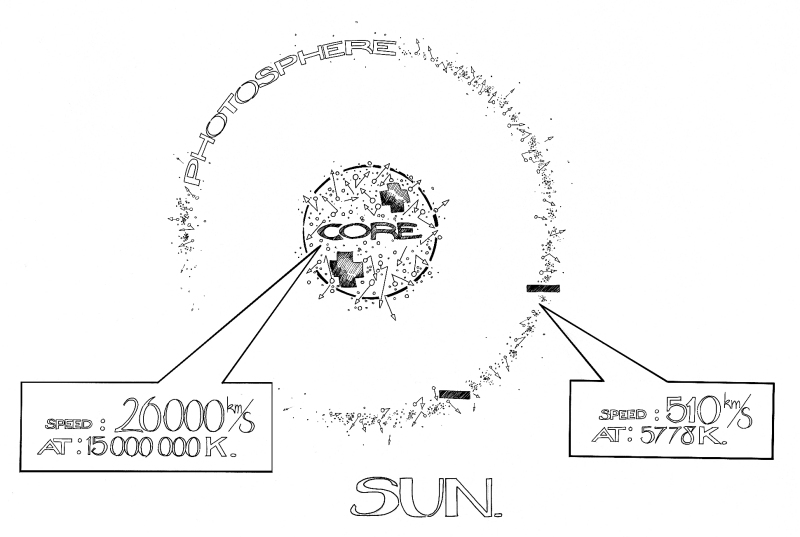
This very quick solar wind cannot be understood without the new thermoelement-law. Astronomy Prof. K.R. Lang (1995) “We do not understand the basic driving mechanism of the solar wind.” (p. 123.) I hope that my readers are happy. My new thermoelement-law simply and automatically explains “the basic driving mechanism of the solar wind”. It explains also all wind-measurements of Skylab, IMP-8, Ulysses in all details. It is evolved in the chapter on the wind. The electric circuit of this solar thermoelement is very simple
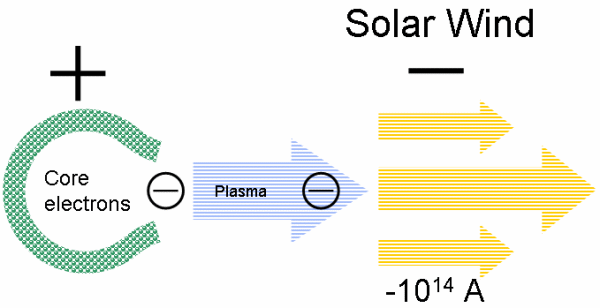
The thermoelement electrons come out from the Sun not due to the 2 000 V thermovoltage, but the thermovoltage is the result of the pushed electrons in the Sun. The same is valid in all other terrestrial or celestial thermoelements. Not a section of the Sun is a dynamo (which has no circuit !) but the whole Sun is a simple thermoelement-generator (with a simple circuit). The temperature difference is directly converted to electric energy as in the Pu-batteries of the spacecrafts. No mechanic drive as in the alleged solar dynamo is necessary. In this new and electric astronomy, the inexplicable dynamo is totally substituted with the simple thermoelement. It is not anymore necessary to look for the dynamo’s position in the Sun. Where is the dynamo?
Is it:
- just below the surface (Babcock, Parker, Leighton 1950-1960),
- deep in the convection zone (Kusserow, Denzer 1980-1990)
- just below the convection zone in the rigid body, in the depth of 220 000 km (Scherrer 1997)
- in the core (Lang 1995, Grandpierre 1996)
The “solar dynamo” is nowhere in the Sun. The whole Sun is a thermoelement-generator.
All thermoelement-parameters are measurable. The current of this thermoelement is transported by the solar wind. The solar thermoelement does not produce inductive current. It needs only temperature difference, not rotation. This generator is absolutely not braked by the induction according to the Lenz-law. The wind moves antigravitationally. An electrically neutral explanation has only the heat-motion which can move upwards. Particles should push particles in all directions, also upwards. This electrically neutral wind would be a neutral thermal evaporation of the hot solar surface. But the thermal cause of the fast solar wind should have a temperature of 24 MK according to the Boltzmann-equation0.5 mv² = 1.5 kT (1)(M. 01). However, this very high temperature is nowhere to be found on the surface (nor in the whole Sun). Parker supposed only 2 MK. But this is also non-existent on the surface and not detectable as emitted mass in the heliosphere. The corona, as a wind-source, is impossible due to the fact that the solar wind exists (it is even strongest, then) when no corona is present (4.67).
Yohkoh´s and SOHO´s sharp pictures do not show a trace of an evaporating process of the coronal loops. These beautiful pictures were not available in Parker´s time. According to the electric model, the corona is not hot but positive (see below). Naturally, a positive corona cannot emit a negative wind.Instead of the heat, the wind-particles are simply emitted and accelerated electrically in a cold way. Their direction in this model is automatically correct: only upwards (4.47) and not in all directions as in the case of an evaporation ! These particles do not collide, they fly on parallel orbits, along the electric field. This is why they do no emit electromagnetic waves while flying along their almost straight orbits. The Sun is similar to an electrostatic paint-jet, not to a torch paint-jet. The stellar wind is negatively charged, therefore, it has no recombination light: it repulses electrons. During 9 eclipses of the Maunder Minimum the solar wind was invisible for unaided eyes. But it would be also undetectable in X-ray. However in the present time, the wind drags along positive ions from X ray bright points which appear always separated on the poles (4.56, 4.68). This electrostatically attracted positive matter has also no collisions, but it has recombination light, and therefore, it is visible as “polar filaments” during the eclipse (4.56) or in EUV (1.10, 4.10). These filaments makes the wind and the electric field indirectly visible similar to aluminium slices fluids or air (4.30). These positive filaments are no components of the negative wind. Their “temperature” of 1.5 MK (table 4.8) is not the “temperature” of the wind. They are also no “somehow transformed” magnetic force-lines. The “polar magnetic force-lines” were not found by Ulysses. Here again, the energy of the windprotons (M) corresponds to 24 MK and not 1.5 MK or 2 MK (M.01). But, the stellar wind is no moving gas and its motion energy is not transformed to heat.
Section title
- Author
- Dr. Lászlo Körtvélyessy
- Published at
- 1992-05-02
- Download
- PDF file 157 kB
On this page